









































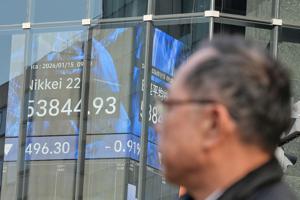
Asian shares and U.S. futures experienced a modest uptick on Friday following a series of turbulent trading days. In Tokyo, the Nikkei 225 index rose by 0.2% to close at 53,800.28 after the Bank of Japan decided to keep its key interest rate unchanged at 0.75%. This decision came after a recent increase in December, reflecting the central bank’s cautious approach to economic management.
The Bank of Japan’s policy meeting concluded with a slight upgrade in its forecasts for future inflation and economic growth. Despite the positive outlook, the Japanese yen weakened against the U.S. dollar, trading at 158.64 yen, up from 158.42 yen. According to Abhijit Surya of Capital Economics, “With underlying inflation price pressures remaining firm, we expect the Bank of Japan to resume its tightening cycle in the coming months.”
Chinese markets also showed positive movement. The Hang Seng index in Hong Kong gained 0.3% to reach 26,718.13, while the Shanghai Composite index mirrored this increase, closing at 4,133.58. South Korea’s Kospi climbed 0.6% to 4,983.36, having briefly surpassed the 5,000 mark on Thursday before retracting later in the session. In Australia, the S&P/ASX 200 edged up 0.2% to 8,862.20, while Taiwan’s Taiex surged 0.8%. The Sensex in India remained nearly unchanged.
In the U.S., the S&P 500 rose 0.5% to 6,913.35, continuing its recovery after President Donald Trump announced the cancellation of tariffs on certain European nations. The Dow Jones Industrial Average also increased by 0.6% to 49,384.01, with the Nasdaq composite gaining 0.9% to close at 23,436.02. Despite these gains, investors expressed caution regarding the uncertain details of a potential deal involving Greenland, reportedly reached between Trump and NATO officials, which remains unsigned.
The U.S. stock market experienced its most significant drop since October earlier this week, prompting Trump to acknowledge the downturn. This fluctuation has led to the emergence of the acronym “TACO,” suggesting that “Trump Always Chickens Out” in response to strong market reactions. Notably, shares of JPMorgan Chase rose 0.5% following Trump’s lawsuit against the bank, accusing it of closing his accounts for political reasons after his departure from office in 2021.
Treasury yields remained relatively stable, indicating that foreign investors are not exiting the U.S. bond market in large numbers. Recent data provided support for these yields, highlighting a lower-than-expected number of unemployment benefit applications and suggesting that the U.S. economy is experiencing stronger growth than previously estimated. Inflation rates for November also aligned closely with forecasts, while consumer spending showed slight improvements.
Global markets have seen a degree of stabilization following a decline in long-term Japanese government bond yields, which had surged earlier in the week amid concerns regarding potential fiscal policies from Japan’s Prime Minister Sanae Takaichi. The yield on 40-year Japanese government bonds decreased to 3.0955% after peaking at a record of more than 4%.
In commodities, the price of gold rose 0.8%, staying near the $5,000 mark, while silver increased by 2.3%. Such movements in precious metals often occur when investors seek safer assets. Additionally, U.S. benchmark crude oil prices climbed by $0.52 to $59.88 per barrel, and Brent crude rose $0.54 to $64.60 per barrel. The euro experienced a slight decline, trading at $1.1750 from a previous $1.1755.
As global markets adjust to these developments, investors will be closely monitoring economic indicators and geopolitical events that may influence future financial stability.
















